How to Read Portfolio Drawdowns With Confidence
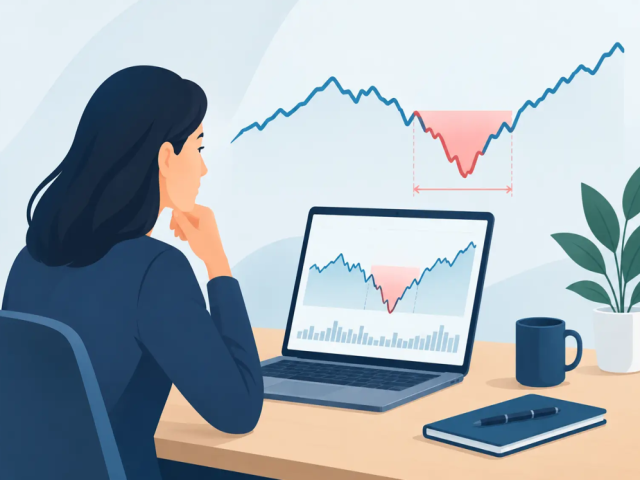
Learn how to read portfolio drawdowns, separate normal market moves from warning signs, and make calmer decisions aligned with your investment goals now.
A portfolio can be profitable over time and still show periods of decline. Knowing how to read portfolio drawdowns helps you see those declines in context, instead of letting one difficult week or month dictate an emotional decision. For investors pursuing passive income and long-term financial well-being, this is one of the clearest ways to replace panic with perspective.
A drawdown is not automatically a sign that an investment strategy has failed. Markets move through expansions, corrections, recoveries, and sudden shocks. What matters is how far the portfolio fell, how long it remained below its previous high, why it happened, and whether the movement still fits your personal investment horizon.
What a portfolio drawdown actually shows
A drawdown measures the decline from a portfolio's highest value to its lowest value before it reaches a new high. If your account grows from $10,000 to $12,000, then declines to $10,800, the drawdown is $1,200. Expressed as a percentage, that is a 10% drawdown from the $12,000 peak.
The starting point matters. Drawdowns are calculated from the high-water mark, not from your original deposit. That distinction can be surprising. In the example above, the account is still above the initial $10,000 contribution, yet it is experiencing a drawdown because it has fallen from its most recent peak.
This figure gives investors a plain-language view of downside movement. It answers a practical question: how much value was temporarily lost before recovery began? For a managed portfolio, it can also help you understand whether the strategy's risk level matches the opportunity you expected.
How to read portfolio drawdowns without overreacting
Start by looking at the percentage, not just the dollar amount. A $500 decline may feel significant in a $5,000 portfolio, but it has a different meaning in a $100,000 portfolio. Percentages make performance easier to compare across account sizes, investment programs, and time periods.
Next, look at the time frame. A 5% decline over a single volatile trading day is different from a 5% decline that continues for several months. Short-term market activity can be driven by earnings reports, central bank decisions, geopolitical news, currency changes, or a broad risk-off move across global markets. A prolonged decline may call for closer attention to the portfolio's holdings, strategy, and market conditions.
Then compare the drawdown with the portfolio's intended role. A short-term allocation for an upcoming purchase should generally carry less tolerance for deep fluctuations than a long-term wealth-building allocation. There is no universally acceptable drawdown level because the right level depends on your target return, timeline, liquidity needs, and comfort with market uncertainty.
A portfolio designed for broad exposure to equities, currencies, cryptocurrencies, indices, and commodities may experience different patterns of movement than one focused on a single asset class. Diversification can reduce reliance on one market, but it does not eliminate losses. When major markets decline together, even diversified portfolios can fall temporarily.
The four details that make a drawdown meaningful
A single number is useful, but it is incomplete. To make a better decision, read drawdowns through four connected details:
- Depth: How far did the portfolio fall from its high? A 3% decline and a 30% decline require very different levels of emotional and financial preparedness.
- Duration: How long has the portfolio remained below its previous peak? Recovery time affects both cash-flow plans and investor confidence.
- Frequency: Does the strategy experience occasional declines, or repeated sharp losses? Frequent volatility may indicate a higher-risk approach than you intended to hold.
- Recovery behavior: Has the portfolio historically recovered from comparable periods, and did the recovery come from a disciplined process rather than a one-time market rebound?
These details work together. A shallow drawdown that lasts several weeks may be easier to manage than a severe decline that rebounds quickly, especially if you need access to capital soon. On the other hand, an investor with a long horizon may accept temporary fluctuations if the portfolio's return potential and management approach remain aligned with their goals.
Normal volatility versus a potential warning sign
No investment program can promise uninterrupted gains. Daily account changes are part of participation in financial markets, particularly when portfolios have exposure to actively moving assets such as stocks, currencies, commodities, and crypto markets.
Normal volatility often appears during broad market pressure. For example, a portfolio may decline alongside major equity indexes or risk assets after inflation data, an interest-rate decision, or unexpected global news. In those moments, the key question is whether the portfolio is moving in line with its stated market exposure and risk profile.
A drawdown deserves more attention when it is substantially larger than what the strategy normally experiences, when it continues while relevant markets recover, or when you cannot clearly understand the source of the loss. Transparency matters here. Investors should be able to review account values, recent activity, portfolio allocation, and the general approach being used to manage risk.
Do not confuse activity with protection, however. Frequent trades do not guarantee better outcomes, and a temporary recovery does not prove that a strategy is sound. A professional management process should include market monitoring, defined risk controls, and regular visibility into performance, but it should also acknowledge that losses can occur.
Why the recovery period matters as much as the decline
Many investors focus only on the percentage lost. Recovery math shows why the path back matters. A 10% decline requires an 11.1% gain to return to the prior high. A 20% decline requires a 25% gain. A 50% decline requires a 100% gain.
That does not mean investors should abandon every portfolio after a decline. It means deeper losses require stronger future performance to recover, making risk management a central part of long-term investing. The goal is not to avoid every drawdown, which is unrealistic. The goal is to avoid taking more risk than your plan, financial position, and timeline can support.
For passive investors, this is especially relevant. If you have chosen managed market exposure because you do not want to trade every headline yourself, a pre-defined plan can protect you from changing direction at the worst possible moment. Selling after a decline may turn a temporary paper loss into a permanent one. Holding without reviewing whether the strategy still fits can also be a mistake. The balanced approach is to assess, not react.
A practical way to review drawdowns in your account
Set a regular review schedule rather than checking performance compulsively. Weekly or monthly reviews are often more useful than reacting to every market update, depending on your program and time horizon. Use the same questions each time: What is the current drawdown from the high? What market conditions contributed to it? Is the portfolio behaving as expected? Has anything changed in my own financial needs?
Keep your goals visible beside the performance chart. If the money is intended for long-term growth, short-term fluctuations may carry less weight than consistency, diversification, and recovery potential. If you may need the funds soon, a drawdown may reveal that your allocation is too aggressive for that purpose.
It also helps to separate deposits and withdrawals from investment results. Adding capital can make an account balance look stronger even if the underlying portfolio is below its prior high. Withdrawing funds can make the balance appear lower without representing an investment loss. A clear dashboard and transaction history make this distinction easier to see.
At Budrigantrade, portfolio visibility is designed to help investors follow their managed exposure without needing to execute day-to-day trades themselves. Still, every investor should understand the performance information available, ask questions when a movement is unclear, and avoid treating past gains as a guarantee of future results.
Let drawdowns improve your decisions
The most useful drawdown is not the one you never see. It is the one that reveals whether your investment plan is built for the real behavior of markets. If a temporary decline makes you unable to sleep, unable to meet near-term obligations, or ready to exit without reviewing the facts, the issue may be the portfolio's risk level rather than the latest market move.
Use drawdowns as a checkpoint for alignment. A well-chosen investment approach should give you a realistic path toward passive income or long-term growth while leaving room for the uncertainty that comes with global markets. Calm investors are not investors who expect no declines. They are investors who understand what a decline means, what they own, and what they are prepared to hold through.
Recent Posts
-

-

Liquidity Planning for Investors That Works
26 Oct 2026
-

Can Entities Invest? A Practical Path to Growth
26 Oct 2026
-

-

High Yield Savings Versus Investing: Which Fits?
26 Oct 2026
-

Guide to Economic Indicators for Investors
22 Oct 2026
-

Retirement Portfolio Diversification Example
22 Oct 2026
-
When Portfolios Rebalance and Why It Matters
22 Oct 2026
-
How to Rebalance a Multi Asset Portfolio
22 Oct 2026
-

How to Protect Investment Accounts From Fraud
22 Oct 2026
-
What Is Investment Liquidity and Why It Matters
20 Oct 2026
-

How to Set Financial Goals That Build Wealth
20 Oct 2026
-

Robo Advisors Versus Brokers for Your Goals
20 Oct 2026
-

-