Custodial Wallets Versus Exchanges Explained
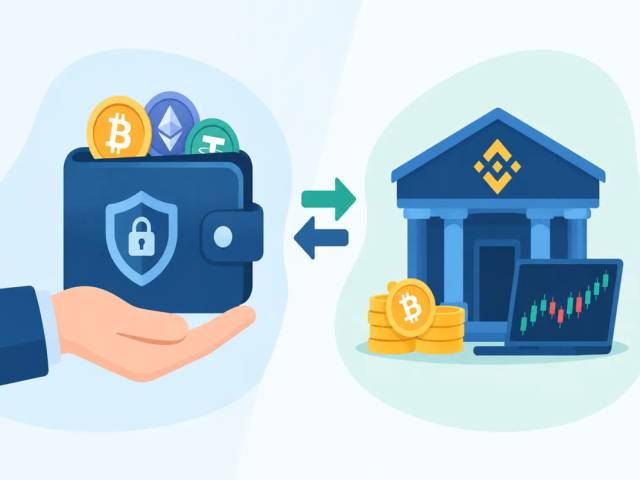
Custodial wallets versus exchanges: compare control, trading access, security, fees, and withdrawal rules before moving money or investing online safely.
A crypto deposit can look deceptively simple: choose an asset, copy an address, send funds, and wait for the balance to appear. But custodial wallets versus exchanges is not a minor technical distinction. It determines who holds the keys to your assets, how quickly you can trade, what happens if you lose access, and how much responsibility sits on your shoulders.
For investors who want exposure to digital assets without spending every day managing trades, the right setup should support convenience without creating blind spots. A clear understanding of custody helps you move money with more confidence and choose services that fit your investment goals.
What Is a Custodial Wallet?
A custodial wallet is a wallet where a third-party provider holds and manages the private keys associated with your crypto assets. Private keys are the credentials that authorize transactions on a blockchain. Whoever controls them has practical control over the ability to move the funds.
With a custodial wallet, the provider handles that technical responsibility. You access your account with a login, password, and ideally two-factor authentication, much like you would access an online banking or investment account. The provider may also manage transaction approvals, wallet infrastructure, security monitoring, recovery processes, and compliance checks.
This arrangement is often attractive for beginners and passive investors. There is no seed phrase to write down, no hardware device to maintain, and no risk of permanently losing access because a recovery phrase was misplaced. If you forget an account password, a reputable provider may offer a verified account-recovery process.
The trade-off is straightforward: you are trusting the custodian to safeguard assets and honor withdrawals under its policies. That makes provider selection a financial decision, not simply a convenience decision. Review its security practices, account protections, withdrawal process, supported assets, fees, and customer support before depositing meaningful capital.
What Is a Crypto Exchange?
A crypto exchange is a marketplace where users can buy, sell, swap, and sometimes earn yield on digital assets. Its primary role is facilitating transactions between buyers and sellers or providing liquidity through its own trading systems.
Most centralized exchanges automatically give customers custodial wallets. When you buy Bitcoin, Ethereum, or another asset on the platform, the exchange typically records your balance in its internal system while holding the private keys on your behalf. This is why the terms can be confused: an exchange commonly includes custodial wallet services, but it is not only a wallet.
An exchange is built for market access. It may offer price charts, limit orders, recurring purchases, conversions between assets, and fiat currency deposits or withdrawals. A custodial wallet, by comparison, may focus mainly on holding, receiving, and sending assets. Some wallet providers do include swaps or purchases, but trading is not necessarily their central purpose.
The Difference Comes Down to Function
Think of a custodial wallet as the account where an institution safeguards access to your crypto. Think of an exchange as the venue where you transact. In many cases, the same company provides both functions through one dashboard.
That convenience can be useful. You can fund an account, purchase an asset, and monitor your balance without transferring funds across multiple services. Yet it also means you should understand whether your assets are held in a trading account, a separate custody product, or a wallet that you control yourself.
Custodial Wallets Versus Exchanges: The Key Trade-Offs
Neither option is automatically better for every investor. The more useful question is what you need your crypto to do next.
Control and responsibility
A custodial wallet places operational responsibility with the provider. This can reduce the chance that an individual mistake, such as exposing a seed phrase or sending funds from the wrong device, causes an irreversible loss. It is a practical choice for people who value guided access and account recovery.
An exchange can also be custodial, so it offers similar ease of access. However, funds left on an exchange are generally positioned for trading activity. If your objective is to hold assets over time rather than react to daily price movements, a dedicated custody arrangement may feel more aligned with that purpose.
Neither setup eliminates personal responsibility. You still need a unique password, two-factor authentication, careful device security, and skepticism toward unsolicited messages. No legitimate provider should ask you to disclose passwords, verification codes, or recovery credentials.
Trading speed and market access
Exchanges are usually the better fit when you want to purchase assets, rebalance positions, or convert crypto into cash regularly. Prices move quickly, and an active exchange interface gives you tools to act when your strategy calls for it.
A custodial wallet can be better suited to investors who primarily need secure holding and straightforward deposits or withdrawals. It removes some of the noise of a trading screen, which can be helpful when your plan is based on a longer time horizon rather than short-term market swings.
For managed investment users, this distinction matters. Market execution may be handled through a platform or strategy, while the wallet function supports funding, custody, and withdrawals. Always understand where your assets are held and which party is authorized to make trades.
Security model
Security is not just a feature list. It is a combination of technology, procedures, and human behavior. A capable custodian may use encrypted systems, cold storage for a portion of assets, transaction monitoring, multi-factor controls, and dedicated security teams. Those resources can offer reassurance to users who do not want to manage complex wallet security alone.
Exchanges also invest heavily in security, but they are frequent targets because they process high volumes of transactions and maintain large pools of customer assets. A well-known name is not a substitute for due diligence. Check whether the provider clearly explains its security practices, withdrawal safeguards, and procedures for unusual account activity.
It is also wise to avoid keeping more on a trading platform than your near-term strategy requires. This is not because exchanges are inherently unsafe. It is because concentration risk exists whenever a single service holds a significant portion of your assets.
Fees, limits, and access to funds
An exchange may charge trading fees, spreads, conversion fees, network fees, or fees for certain withdrawal methods. A custodial wallet may charge network fees for transfers and may have its own service costs depending on the provider and product. Read the schedule before you fund an account rather than discovering costs after a transaction is underway.
Withdrawal limits deserve equal attention. Providers may impose daily limits, verification requirements, waiting periods after password resets, or additional reviews for unusually large transfers. These measures can protect accounts, but they can also affect your ability to move funds on a specific timetable.
For this reason, investors should match the service to their liquidity needs. Money needed for a near-term expense should not be committed to an arrangement with restrictions you have not reviewed. Crypto values can be volatile, and access rules matter just as much as market prices.
How to Choose the Right Setup for Your Goals
Start with your purpose. If you want frequent buying, selling, and price-based decisions, an exchange offers the market tools you will likely need. If you want a simpler place to receive, hold, and send assets while a provider manages the technical side of custody, a custodial wallet may be the more comfortable option.
Next, assess the provider instead of relying on labels. Look for transparent terms, clear fee disclosures, strong authentication options, a visible withdrawal process, and responsive support. Confirm which assets and blockchain networks are supported before sending funds. Sending an asset over an unsupported network can lead to delays or permanent loss.
Finally, keep your investment plan in view. Crypto can support diversification, but it should fit your time horizon, risk tolerance, and need for available cash. A platform that makes participation easy should also make account activity, balances, and withdrawal rules easy to understand.
The strongest choice is the one that gives you enough access for your strategy, enough protection for your comfort level, and enough clarity to make decisions without guesswork. When your custody arrangement matches your goals, digital assets can become a more organized part of your broader financial well-being.
Recent Posts
-

-

12 Best Questions for Investment Providers
17 Nov 2026
-

Why Markets Fluctuate and What It Means for You
17 Nov 2026
-

How Decentralized Finance Regulation Affects You
17 Nov 2026
-

-

-
-

7 Best Automated Savings Methods for Investors
10 Nov 2026
-

What Causes Market Volatility? Key Drivers
10 Nov 2026
-

Small Business Treasury Allocation That Works
09 Nov 2026
-
Best Practices for Investor Cybersecurity
09 Nov 2026
-

What Causes Investment Losses? 7 Key Reasons
09 Nov 2026
-

Investment Risk Comparison for Smarter Choices
09 Nov 2026
-

ETFs Versus Mutual Funds for Investment Goals
09 Nov 2026
-