What Causes Market Volatility? Key Drivers
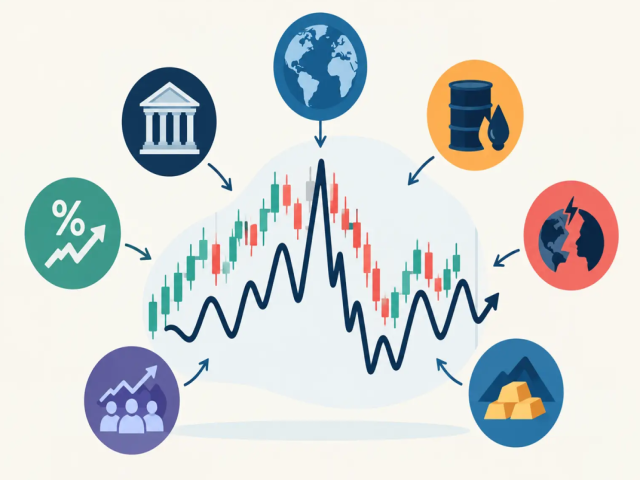
What causes market volatility? Learn how rates, earnings, global events, liquidity, and sentiment move prices, and how a managed approach can help investors respond.
A market can look calm at breakfast and be moving sharply by lunchtime. A central bank comment, an unexpected inflation report, a corporate earnings surprise, or a headline from abroad can change what investors believe prices are worth. Understanding what causes market volatility helps investors see those moves as part of market behavior, not as a reason to make rushed decisions.
Volatility is the rate and size of price movement in an asset or market. It can affect stocks, currencies, commodities, indices, and cryptocurrencies, sometimes all at once. Higher volatility creates more uncertainty, but it also creates the price movement that active market participants look for. The question is not whether volatility will happen. It is what is driving it, how long the pressure may last, and whether your investment approach matches your time horizon.
What Causes Market Volatility in Practice?
Market prices reflect expectations. When new information challenges those expectations, buyers and sellers quickly reassess risk, growth potential, earnings, and future cash flow. If many participants reach the same conclusion at the same time, prices can move quickly.
The same event does not always produce the same result. A higher interest rate can hurt one group of companies while supporting another. A weaker currency can raise import costs but benefit exporters. This is why headlines alone are not an investment strategy. Context, positioning, and market conditions matter.
Interest rates and inflation expectations
Interest rates are among the strongest drivers of asset prices. When borrowing costs rise, consumers and businesses may spend less, corporate financing becomes more expensive, and future company earnings can appear less attractive. Growth-focused stocks often react strongly because more of their expected value depends on profits further in the future.
Inflation adds another layer. If prices for goods and services rise faster than expected, investors may anticipate tighter monetary policy. Bond yields can move, currencies can react, and equities may reprice within minutes of an inflation release. On the other hand, falling inflation can support confidence that rates may stabilize or decline.
For investors seeking passive exposure, the practical lesson is simple: rate decisions affect more than bonds. They can influence every part of a diversified portfolio, from technology shares and bank stocks to gold, oil, and digital assets.
Corporate earnings and changing business outlooks
A company’s earnings report is a direct test of whether its business is meeting expectations. Revenue, profit margins, debt, customer growth, and forward guidance can all move a stock. When major companies disappoint, the effect may spread across an entire sector or index.
Markets are especially sensitive to the gap between expectations and reality. A business can report higher profits than last year and still fall if investors expected more. Likewise, a company with modest current results may rise if its outlook improves. Price action is often about the future, not the past quarter alone.
During earnings season, volatility can increase as thousands of companies provide new information in a compressed period. Broad market moves may reflect a handful of large firms whose performance carries significant weight in major indexes.
Economic data and recession concerns
Employment reports, consumer spending figures, manufacturing data, housing numbers, and gross domestic product estimates offer clues about economic momentum. Strong data can signal healthy demand, but it may also increase concerns that inflation or interest rates will remain elevated. Weak data can raise recession fears, yet it can sometimes lift markets if investors believe rate cuts are more likely.
That apparent contradiction is a core feature of volatility. Markets do not react to data in isolation. They react to what the data means relative to current expectations. A report that would have been positive three months ago may be seen as negative under a different interest-rate outlook.
Geopolitical events and policy surprises
Elections, trade restrictions, military conflict, sanctions, supply disruptions, and unexpected government decisions can cause rapid repricing. These events are difficult to forecast because their economic impact may be unclear at first.
Energy and commodity markets are often highly responsive. A threat to shipping routes or production facilities can affect oil prices quickly. Currencies may move as investors seek perceived safety or reassess the outlook for a specific country. Equity markets can decline when uncertainty rises, particularly in sectors with global supply chains.
Not every geopolitical headline creates a lasting trend. Some market reactions fade once facts become clearer. Others reshape inflation, growth, and corporate profitability for months. A measured approach separates immediate emotion from the longer-term consequences.
Liquidity Can Make Price Swings Larger
Liquidity describes how easily an asset can be bought or sold without meaningfully changing its price. Highly traded assets usually have more buyers and sellers available at many price levels. In less liquid conditions, even a relatively small order can move the market sharply.
Liquidity often becomes thinner outside major trading hours, during holidays, or when fear is high. In crypto markets, where trading runs around the clock, sharp price moves can occur at any hour. Smaller stocks and less frequently traded assets can also experience wider spreads and faster swings.
Leverage can intensify the move. When traders borrow funds to increase exposure, a declining market may trigger forced sales or margin calls. Those sales can push prices down further, creating a feedback loop. The same dynamic can accelerate rallies when short positions are forced to close.
This is one reason volatility should not be confused with value. A sharp move may reflect changing fundamentals, but it can also reflect order flow, limited liquidity, or leveraged positions unwinding.
Investor Sentiment Moves Markets Too
Markets are made of people, institutions, algorithms, and competing views of risk. Fear and optimism influence how participants interpret the same facts. When confidence is high, investors may focus on opportunity and accept more risk. When confidence weakens, they may prioritize capital preservation and sell assets that previously looked attractive.
News coverage and social media can amplify sentiment, particularly in popular stocks and cryptocurrencies. Algorithms can add momentum by reacting to price levels, headlines, or trading volume. None of this means markets are irrational all the time. It means market prices can temporarily move faster than a careful fundamental assessment would suggest.
Sentiment is also why timing is difficult. Investors who chase a fast rally may buy after much of the move has occurred. Investors who sell into panic may lock in a loss just before conditions stabilize. A defined plan provides more discipline than reacting to every notification.
How to Respond Without Letting Volatility Control You
No one can remove uncertainty from investing. The goal is to build an approach that can withstand it. Your response should depend on your objectives, financial position, risk tolerance, and investment timeline.
First, separate short-term needs from long-term capital. Funds needed for bills, emergencies, or a near-term purchase should not be exposed to the same level of market risk as capital allocated for longer-term growth. This creates room to stay patient when normal market swings occur.
Second, consider diversification across asset classes, regions, and market themes. Diversification cannot guarantee profits or prevent losses, and correlated markets can still fall together during stress. However, it can reduce dependence on one company, one currency, or one economic outcome.
Third, focus on risk management rather than predictions. Position sizing, planned entry and exit parameters, portfolio monitoring, and an understanding of liquidity can matter more than trying to forecast every headline. Investors who prefer not to make daily trading decisions may value managed market exposure, where analysts monitor changing conditions and execution is handled within a defined strategy.
Budrigantrade is built for investors who want access to global markets without taking on the full operational burden of watching prices around the clock. Still, managed investing involves risk, and past performance never guarantees future results. Transparency, realistic expectations, and a suitable time horizon should remain central to every investment decision.
Volatility Is Information, Not an Instruction
Market volatility can signal a shift in growth, inflation, policy, earnings, or investor confidence. It can also be temporary noise made louder by low liquidity and emotion. The most productive response is not to ignore volatility or chase it, but to understand what is behind it and keep your financial decisions connected to your larger goals.
When prices move quickly, pause before acting. Ask what changed, whether that change affects your strategy, and whether your portfolio is built for the period ahead. Calm, informed decisions are often the most valuable asset an investor can hold.
Recent Posts
-

-

-

-

7 Best Automated Savings Methods for Investors
10 Nov 2026
-

Small Business Treasury Allocation That Works
09 Nov 2026
-

Best Practices for Investor Cybersecurity
09 Nov 2026
-

What Causes Investment Losses? 7 Key Reasons
09 Nov 2026
-

Investment Risk Comparison for Smarter Choices
09 Nov 2026
-

ETFs Versus Mutual Funds for Investment Goals
09 Nov 2026
-

-

Digital Wealth Management Trends to Watch
01 Nov 2026
-

Is Crypto Transaction Security Important?
01 Nov 2026
-

9 Best Financial Forecasting Tools for Investors
01 Nov 2026
-

Actively Managed Versus Robo Advisors Compared
01 Nov 2026
-