How to Calculate Compound Returns on Investments
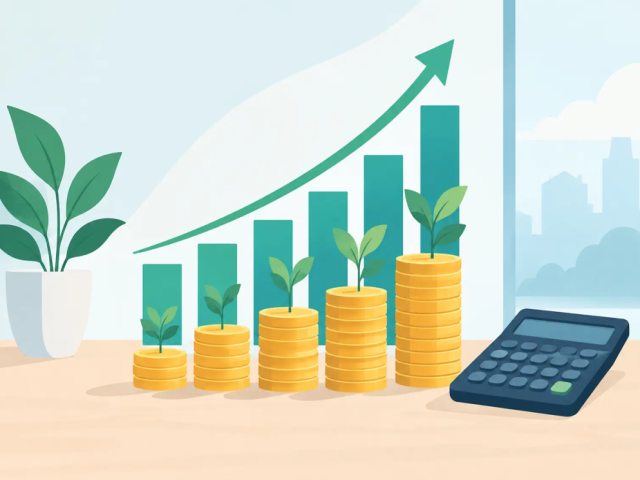
Learn how to calculate compound returns, compare annual and monthly growth, and plan investment goals with examples, formulas, and realistic assumptions.
A $10,000 investment earning 8% a year does not simply produce $800 every year. Once the first year’s gain stays invested, it can generate gains of its own. That snowball effect is why learning how to calculate compound returns matters when you are planning for passive income, a major purchase, or long-term financial well-being.
The calculation is straightforward. Using it wisely requires a little more care. Your projected return depends on the rate you use, how often growth compounds, how long funds remain invested, whether you add money regularly, and the costs deducted from profits.
What compound returns mean for your money
A compound return occurs when investment earnings remain in the account and become part of the balance used to calculate future earnings. You earn a return on your original deposit, then a return on the original deposit plus prior gains.
By contrast, simple returns apply the rate only to the original amount. If you invested $10,000 at a simple 8% annual return for 10 years, the gain would be $8,000, producing a final balance of $18,000. With annual compounding at the same stated rate, the balance would grow to about $21,589.
That $3,589 difference is not a bonus rate or a special trick. It is the value created by giving returns time to remain invested. The longer the timeline, the more meaningful the gap becomes.
How to calculate compound returns with the formula
The standard compound-return formula is:
A = P(1 + r/n)^(nt)
Here, A is the future account value, P is the starting principal, r is the annual return written as a decimal, n is the number of compounding periods per year, and t is the number of years invested.
Suppose you begin with $10,000 and expect an 8% annual return compounded once each year for 10 years. Your calculation is:
A = $10,000(1 + 0.08/1)^(1 x 10)
The result is approximately $21,589. To find the compound return in dollars, subtract your starting principal: $21,589 minus $10,000 equals $11,589 in growth.
The same formula can help you compare different investment timelines. At 8% compounded annually, $10,000 grows to roughly $31,722 after 15 years and $46,610 after 20 years. The additional years are doing more than adding another fixed 8% payment. They allow the accumulated gains to keep working.
Converting a percentage into a decimal
A common calculation error is entering 8 instead of 0.08. Divide the percentage by 100 before using it in the formula. For example, 5% becomes 0.05, 7.5% becomes 0.075, and 12% becomes 0.12.
Also make sure the rate and compounding frequency match. If a projected annual rate is 8% and compounding happens monthly, divide 0.08 by 12. Do not treat 8% as a monthly rate unless that is explicitly how the return has been stated.
Annual versus monthly compounding
Compounding frequency tells you how often earnings are added to the balance. Annual compounding happens once per year. Quarterly compounding happens four times per year. Monthly compounding happens 12 times per year.
Using the same $10,000, 8% projected annual rate, and 10-year term, annual compounding produces about $21,589. Monthly compounding produces approximately $22,196. The difference is modest because the stated rate is the same, but it is real: funds begin compounding sooner.
More frequent compounding is generally favorable when the quoted annual rate is identical. Still, it should not be the only figure guiding your decision. A lower-return opportunity compounded monthly can underperform a higher-return opportunity compounded annually. Focus first on the net return, the risk involved, the strategy behind the return, and the timeframe that fits your financial goals.
Add regular contributions to see the full picture
Many investors do not make one deposit and leave it untouched. They add funds every week, month, or quarter. Regular contributions can be as powerful as the return rate because they steadily increase the capital available to grow.
For recurring monthly contributions, use this expanded formula:
A = P(1 + r/n)^(nt) + PMT [((1 + r/n)^(nt) - 1) / (r/n)]
In this formula, PMT is the amount added each period. It assumes each contribution is made at the end of the period. If you contribute at the beginning of every month, the final value will be slightly higher because each deposit receives one extra month of growth.
Imagine you invest $10,000, add $300 at the end of each month, earn an 8% annual return compounded monthly, and stay invested for 10 years. Your initial $10,000 could grow to about $22,196. Your $300 monthly contributions could grow to about $54,884. Together, the projected value is approximately $77,080.
You would have personally contributed $46,000: the original $10,000 plus $36,000 in monthly deposits. The remaining amount represents projected compound growth. This is why consistent funding can turn an investment plan into a practical engine for long-term wealth building.
Calculate your net compound return, not just the headline rate
A projected gross return is not necessarily the return that reaches your account. Commissions, management costs, transaction spreads, taxes, withdrawals, and inflation can reduce the value you ultimately keep.
If an investment program charges a 20% commission on generated profit, calculate the effect before projecting future growth. For example, a $10,000 balance that earns a gross 10% generates $1,000 in profit. A 20% performance commission on that profit is $200, leaving an $800 net gain before any other applicable costs or taxes. Your end-of-year balance would be $10,800, equivalent to an 8% net return for that year.
This does not mean you should automatically use 8% forever. Returns can change from period to period, and fees may be calculated differently depending on the program. Read the terms, understand when the commission applies, and use the expected net rate in your compound-return estimate whenever possible.
At Budrigantrade, the ability to view portfolio activity and account performance can help investors follow how their capital is being managed. Visibility is useful, but your planning should still be based on the return after applicable profit commissions and on a timeframe you can realistically maintain.
Use realistic assumptions when projecting growth
Compound-return calculations are projections, not promises. Financial markets move. Equities, currencies, cryptocurrencies, indices, and commodities each carry different sources of volatility, and a strong period does not guarantee the next period will match it.
A practical approach is to run three scenarios: conservative, expected, and optimistic. For example, instead of assuming a single 12% annual return for 15 years, compare outcomes at 5%, 8%, and 12%. This shows how sensitive your goal is to the rate and helps you avoid building a plan around only the most favorable outcome.
You should also consider whether returns are reinvested or withdrawn. Reinvesting gives compounding more capital to work with. Withdrawing profits may support current cash-flow needs, but it slows future balance growth. Neither option is automatically better. The right choice depends on whether your priority is income now, capital growth later, or a balance between the two.
A simple way to check your results
You do not need advanced financial software to estimate compound returns. A calculator or spreadsheet can do the work once you know the inputs. Start with your deposit amount, choose a rate that reflects net expected performance, set a compounding schedule, and enter a realistic number of years.
Then test the plan. What happens if you contribute $100 more each month? What if you leave profits invested for five additional years? What if your return is lower than expected for a period? These questions turn a formula into a decision-making tool.
The most valuable compound-return calculation is not the one with the highest possible number. It is the one that helps you set a funding plan, understand the trade-offs, and stay focused on a financial goal long enough for your capital to do meaningful work.
Recent Posts
-

When Should Portfolios Rebalance for Growth?
08 Oct 2026
-

Platform Security Review for Confident Investors
08 Oct 2026
-

How to Invest Business Cash Reserves Wisely
08 Oct 2026
-

Alternative Assets Trends Reshaping Portfolios
08 Oct 2026
-

How to Read Portfolio Drawdowns With Confidence
06 Oct 2026
-

-

Are Investment Platforms Regulated in the US?
06 Oct 2026
-

How to Diversify Income Streams With Purpose
06 Oct 2026
-

Crypto Custody Service Review for Investors
06 Oct 2026
-

A Small Business Cash Reserve Example That Works
23 Sep 2026
-

Retirement Planning That Builds Real Flexibility
23 Sep 2026
-

Stocks Versus Bonds Allocation for Your Goals
23 Sep 2026
-

15 Best Investor Due Diligence Questions
23 Sep 2026
-

15 Best Investor Due Diligence Questions
23 Sep 2026
-

Investment Platform Security Review Made Simple
19 Sep 2026